
Productivity without stress is possible when you manage your energy instead of just your time. It starts with working in focused blocks, setting realistic priorities, and protecting your mental bandwidth.
Most people chase productivity by adding more to their plates. The real breakthrough happens when you remove pressure, simplify your systems, and align your tasks with your natural energy flow.
If you’ve ever felt busy but not fulfilled, overwhelmed but still behind, this guide will show you how to work smarter without running on empty.

Modern work culture often rewards hustle. But constant urgency comes at a cost. Chronic stress reduces focus, weakens decision-making, and eventually leads to burnout.
The truth is simple: stress might push short-term output, but it destroys long-term performance.
When you aim for productivity without stress, you build consistency instead of intensity. You create systems that support your well-being while maintaining meaningful progress.
Here’s what sustainable productivity looks like:
✔ Clear daily priorities
✔ Realistic time blocks
✔ Built-in recovery time
✔ Defined stopping points
✔ Energy-based task planning
This approach helps you work efficiently without constantly feeling behind.
Stress doesn’t just make you tired. It directly interferes with how your brain functions. According to the American Psychological Association, chronic stress impairs memory, concentration, and decision-making abilities, which directly affects workplace performance.
When stress levels rise:
Instead of getting more done, you waste time switching tasks, overthinking, or procrastinating.
| Stress Level | Brain Effect | Productivity Result |
| Low & Managed | Focused attention | Clear execution |
| Moderate | Increased alertness | Short-term output boost |
| High | Cortisol overload | Mistakes, fatigue, burnout |
| Chronic | Cognitive decline | Inconsistent performance |
Working in a constant high-stress state creates diminishing returns. That is why shifting toward productivity without stress leads to more reliable results over time.
Sustainable productivity relies on three pillars: clarity, capacity, and recovery.
Before you start your day, define:
If you need help building better daily systems, explore these practical frameworks in healthy productivity habits for long-term success.
Clear priorities reduce mental clutter and prevent overwhelm before it starts.
Time is fixed. Energy fluctuates.
You have high-energy hours and low-energy hours. The key is to match your hardest tasks to your strongest energy blocks.
This is the foundation behind the system explained in The Energy Bank Method.
Instead of asking “How many hours do I have?” ask:
When you respect your capacity, output becomes smoother and more consistent.
Rest is not a reward. It is part of productivity.
Micro-breaks every 60–90 minutes
A defined end to your workday
Screen-free time in the evening
Weekly review and reset sessions
These prevent stress accumulation.
One practical system many professionals use is the 3–3–3 rule.
Here’s how it works:
This structure prevents overload while ensuring progress across different areas.
It limits unrealistic expectations. Most people cannot sustain 8 hours of high-focus work. The brain simply does not operate that way.
By capping deep work and mixing task intensity, you create a rhythm that supports productivity without stress instead of pushing toward exhaustion.
The goal is not to eliminate responsibility. It is to design smarter workflows.
Instead of long to-do lists, define three meaningful weekly outcomes.
Example:
Everything else supports those three goals.
Create focused blocks of 60–90 minutes.
Add 15–20 minute buffers between blocks to:
This prevents spillover stress.
Ending your workday intentionally reduces mental carryover.
Try this:
This mental closure reduces anxiety.
If you want a deeper dive into slower, more intentional work models, this guide to productivity without hustle is a strong companion read.
| Hustle Model | Sustainable Model |
| Long hours | Focused blocks |
| Constant urgency | Clear priorities |
| Reactive workflow | Planned structure |
| Burnout cycles | Energy renewal |
| Output spikes | Consistent progress |
The hustle model feels productive. The sustainable model actually is.
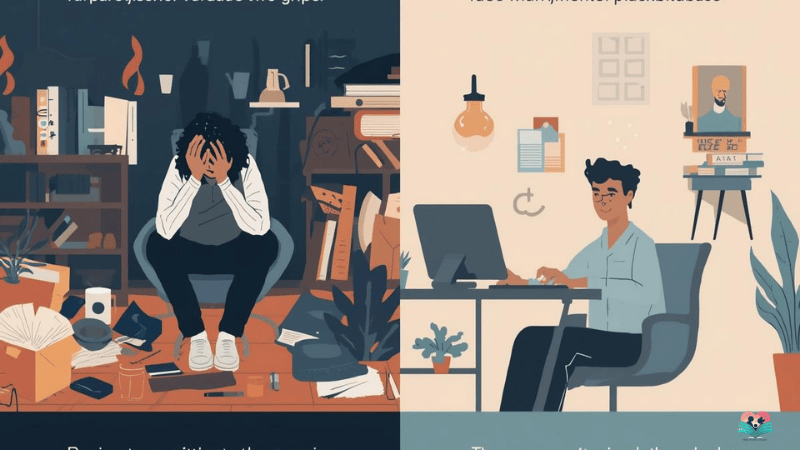
Small shifts make a big difference.
Before checking email:
This prevents reactive days.
Multitasking increases cognitive load and stress. Work on one task at a time.
Set a timer for 25–50 minutes. Focus fully. Then pause.
Your workspace influences stress levels.
✔ Clear desk
✔ Natural light
✔ Minimal notifications
✔ Comfortable seating
These reduce subtle cognitive strain.
You know you are shifting when:
Progress becomes predictable instead of chaotic.
True productivity is not about squeezing more from each day. It is about sustaining effort for years without burnout.
The National Institute of Mental Health explains that prolonged stress affects both mental and physical health, which is why recovery and structured work systems are essential.
This requires:
When your work style supports your nervous system, productivity becomes lighter.

Here is a structured example:
| Day | Focus | Energy Level | Notes |
| Monday | Planning + Deep Work | High | Start the hardest project |
| Tuesday | Execution | High | Continue priority |
| Wednesday | Meetings + Admin | Moderate | Lower focus tasks |
| Thursday | Creative Work | High | Strategy sessions |
| Friday | Review + Light Tasks | Low | Weekly reset |
This model adapts to natural energy cycles instead of fighting them.
Being productive does not mean being busy.
It means:
When you redefine success this way, productivity without stress becomes a realistic outcome instead of a contradiction.
Productivity without stress is not about doing less. It is about doing what matters in a way your mind and body can sustain. When you prioritize clarity, energy management, and recovery, you create consistent results without burnout.
By building supportive systems and aligning your workload with your capacity, you can achieve productivity without stress and maintain it long term.
The key to being productive without stressing is managing your energy instead of forcing constant output. Focus on three meaningful tasks per day, use structured work blocks, and schedule recovery time. Avoid overloading your to-do list. Clear priorities reduce mental clutter. When you plan realistically and protect your breaks, productivity becomes steady instead of exhausting. Stress usually comes from unrealistic expectations, not from the work itself.
The 3-3-3 rule divides your day into three deep work hours, three small tasks, and three maintenance activities. This structure limits cognitive overload while ensuring balanced progress. Instead of trying to stay in high focus all day, you distribute energy intentionally. The method reduces burnout risk and improves consistency. It works especially well for professionals managing both creative and administrative responsibilities.
Stress impacts productivity by reducing focus, increasing mistakes, and draining mental energy. Short bursts of stress can increase alertness, but chronic stress elevates cortisol levels and interferes with memory and decision-making. Over time, this leads to burnout and inconsistent output. Managing stress improves long-term performance and prevents cognitive fatigue that slows progress.
It is possible to work without stress when systems replace urgency and overwhelm. Some pressure is normal, but chronic stress is not required for results. By setting boundaries, defining realistic workloads, and scheduling recovery, you can maintain steady output without burnout. Sustainable productivity is built on clarity and capacity, not constant intensity.
How to Be Productive Without Burning Out: 15 Proven Guide says:
[…] strategy aligns closely with the principles outlined in Productivity Without Stress – 9 Proven Strategies, where the focus is on reducing cognitive […]