
Coloring books for anxiety offer a simple, screen-free activity that can help you slow down, focus on the present moment, and create a calming routine. Research on coloring and other visual art activities suggests they may help reduce anxiety symptoms, although coloring should be viewed as a supportive wellness activity rather than a replacement for professional mental health care.
If you want an easy place to begin, try a relaxing coloring session with the MJ Family Reads coloring book and give yourself a few quiet minutes without worrying about creating a perfect page.
When your thoughts will not slow down, sitting quietly can sometimes feel harder than expected. Your mind keeps jumping between unfinished tasks, tomorrow’s problems, conversations, notifications, and everything else competing for your attention.
Coloring gives your mind something specific to do.
Coloring books for anxiety provide a structured, repetitive activity that directs attention toward choosing colors, following shapes, and filling spaces. That focused activity can create a welcome break from the stream of thoughts demanding your attention.
Research supports this idea. A 2025 systematic review of randomized controlled trials found that visual art interventions – including activities such as drawing, painting, and coloring – were associated with reductions in anxiety across the included studies.
A separate meta-analysis of mandala coloring found an important nuance: mandala coloring did not significantly outperform free drawing for reducing state anxiety. The researchers suggested that both activities may offer anxiety-reducing benefits.
That means you do not necessarily need the “perfect” design. The simple act of putting your attention into a creative activity may be part of what makes coloring useful.
If stress relief is your main goal, explore our guide to adult coloring books for stress relief for more ways to build coloring into your downtime.
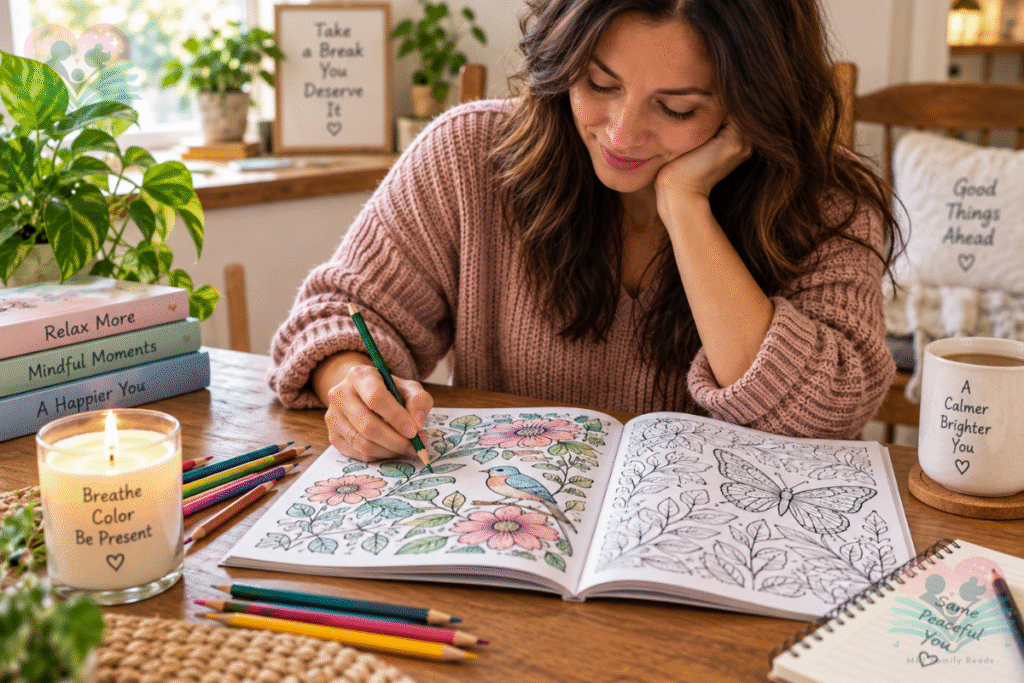
Coloring may help with anxiety by giving your attention a clear, manageable task while encouraging a slower, more focused activity. Instead of trying to force anxious thoughts away, you spend time choosing colors, following patterns, and watching a picture gradually come together.
Researchers have explored this effect in several settings.
For example, a randomized controlled trial involving burn patients found that participants who spent 30 minutes coloring a mandala experienced lower anxiety scores than the control group during the study. Another randomized study involving women during the climacteric period also reported lower post-intervention anxiety scores in its mandala-coloring group.
A broader 2025 meta-analysis covering 35 randomized controlled trials and 3,167 participants found that visual art therapy was associated with improvements in anxiety symptoms. However, the authors rated the overall evidence as very low quality, so these findings should be interpreted carefully.
For everyday use, you can think of coloring as a simple relaxation tool, alongside activities such as journaling, walking, reading, breathing exercises, or listening to calming music.
For more ideas, read our guide to using a stress relief coloring book as a simple way to unwind.
The best coloring books for anxiety are easy to start, visually appealing, and suited to the amount of focus you want to give them. A design that feels relaxing to one person may feel frustrating to another, so choose pages that make you want to pick up your pencils rather than ones that feel like another task to finish.
Here are a few features worth considering:
| Feature | Why It Can Help |
| Simple patterns | Easier to begin when your mind already feels busy |
| Detailed designs | Give you a longer activity to focus on |
| Nature themes | Can create a peaceful visual experience |
| Mandalas and repeating patterns | Provide structure and repetition |
| Variety of designs | Lets you choose a page based on your mood |
| Single-sided pages | Can make coloring and displaying finished artwork easier |
Do not worry about finding a coloring book that checks every box. The best option is one you will actually enjoy using.
You can start with the MJ Family Reads coloring book if you want to make coloring part of your relaxation routine.
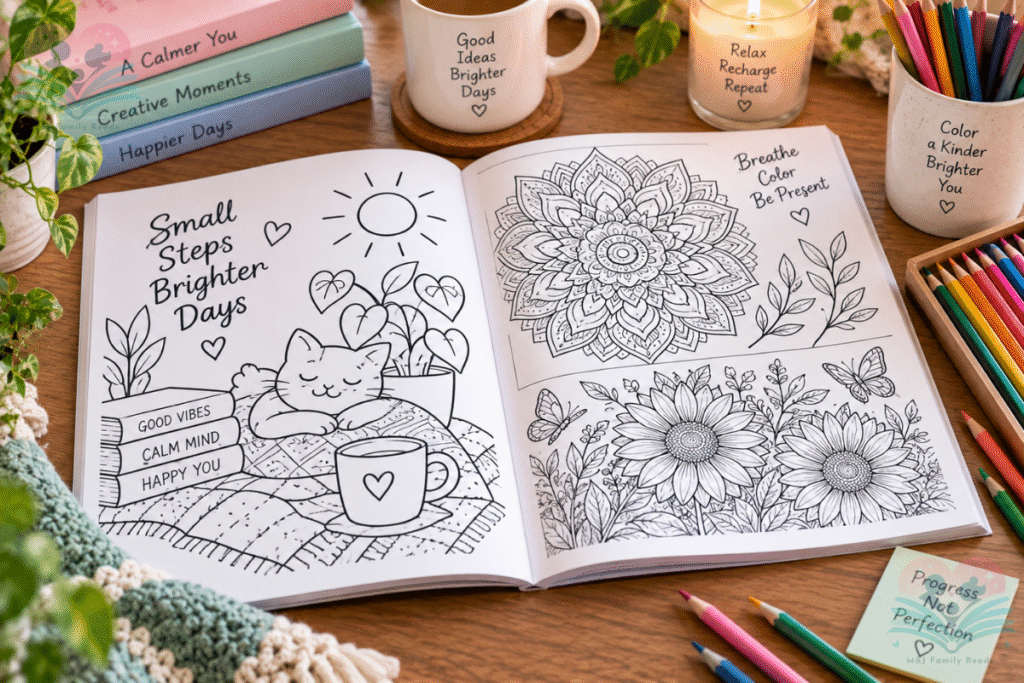
You do not need a complicated routine to use coloring for relaxation. Start with 10 to 20 minutes, choose a page that feels manageable, and focus on the process instead of the finished result. Your coloring does not need to be neat, coordinated, or worthy of sharing with anyone.
Try creating a simple ritual around it. Put your phone away, sit somewhere comfortable, choose a few colors, and begin with whatever part of the page catches your attention.
You might color:
No rule says you have to complete an entire page. Five peaceful minutes can still be worthwhile.
Coloring is not limited to adults, either. Younger people may also enjoy creative activities during their downtime. Our guide to coloring books for teens explores how coloring can give teenagers another screen-free way to relax.
No. Coloring books for anxiety should not be treated as a replacement for professional care when anxiety is persistent, severe, or interfering with everyday life. Coloring is better understood as an accessible self-care or relaxation activity that can complement other forms of support.
This distinction matters because “art therapy” and casual coloring at home are not exactly the same. Formal art therapy is a therapeutic intervention that can involve trained professionals and specific treatment goals.
Research into visual art interventions is promising, but evidence varies considerably by intervention and population. Earlier systematic research also highlighted limitations, including small studies and risk of bias, while newer reviews have reported more encouraging results.
So keep the expectations simple.
Color because it gives you a quiet activity. Color because you enjoy watching a blank design come alive. Color because twenty minutes away from your phone feels good.
Those are worthwhile reasons on their own.
Coloring may help some people experience short-term relaxation and reduced anxiety. Studies of coloring and broader visual art interventions have reported encouraging results, although the quality and strength of the evidence vary.
Choose designs you personally find relaxing. Some people prefer detailed mandalas and repeating patterns, while others enjoy simple flowers, animals, landscapes, or cozy illustrations. A page should feel inviting, not overwhelming.
There is no required amount of time. Research has tested sessions of different lengths, including short sessions around 30 minutes. For everyday relaxation, start with 10–20 minutes, and adjust based on what feels comfortable.
Coloring can be used as a mindful activity when you intentionally focus your attention on the colors, movements, shapes, and experience in front of you. However, coloring itself is not automatically equivalent to formal mindfulness practice or therapy.
No. Adults, teenagers, and children can enjoy coloring. The most important consideration is choosing designs appropriate to the person’s age, interests, and desired level of complexity.
Coloring books for anxiety can turn a few ordinary minutes into intentional quiet time. No complicated technique to master and no pressure to create something perfect. Pick a page, choose your colors, and focus on one small section at a time.
Research suggests creative visual activities may help reduce anxiety, while also reminding us not to overstate what coloring alone can accomplish.
If you are ready to create a relaxing coloring routine, discover the MJ Family Reads coloring book on Amazon and choose a page that makes you want to slow down and start coloring.