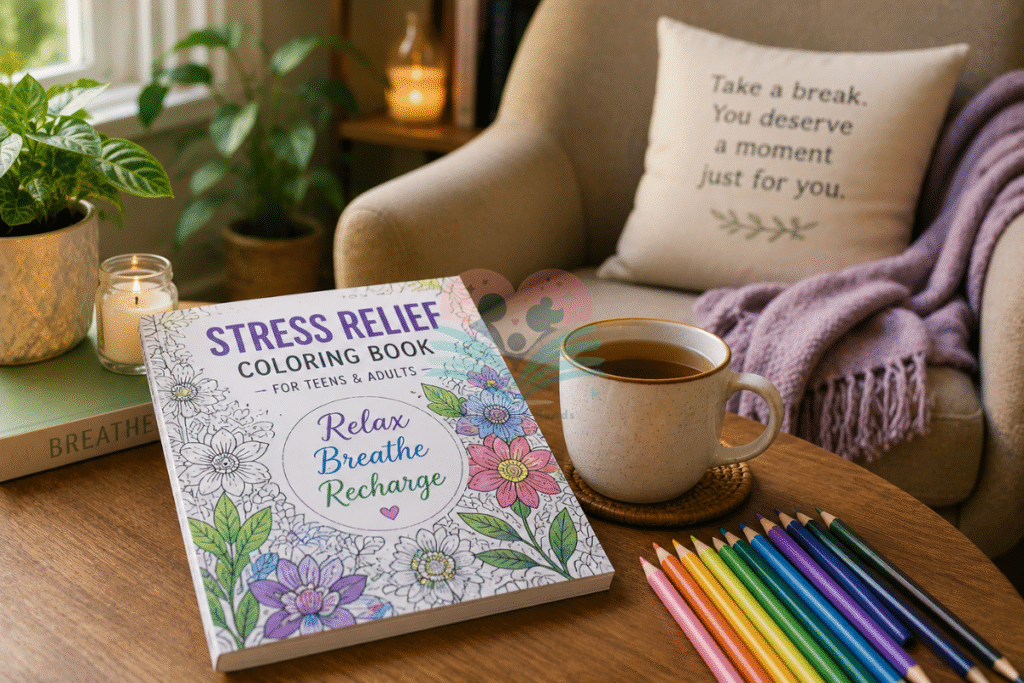
A stress relief coloring book gives adults a simple, screen-free way to slow down, focus on one activity, and create a calmer moment in a busy day. Research on structured coloring, particularly mandala coloring, suggests it may help reduce stress and anxiety, though it should be viewed as a relaxing activity rather than a replacement for professional mental health care.
If you want to turn a few quiet minutes into a creative self-care ritual, explore the Stress Relief Coloring Book from MJ Family Reads.
Stress has a way of following you everywhere.
You finish work, close the laptop, sit down to relax – and your mind is still going through tomorrow’s tasks, unanswered messages, family responsibilities, and everything else competing for your attention.
A stress relief coloring book offers something refreshingly simple: one page, a few colors, and a task that does not require you to solve another problem.
No score to beat and no notification demanding your attention.
You simply choose a color and begin.
That makes coloring an easy addition to a self-care routine, particularly when you want something more engaging than simply sitting still.
For people looking for a creative way to unwind, the Stress Relief Coloring Book from MJ Family Reads can become part of those quiet moments at home.
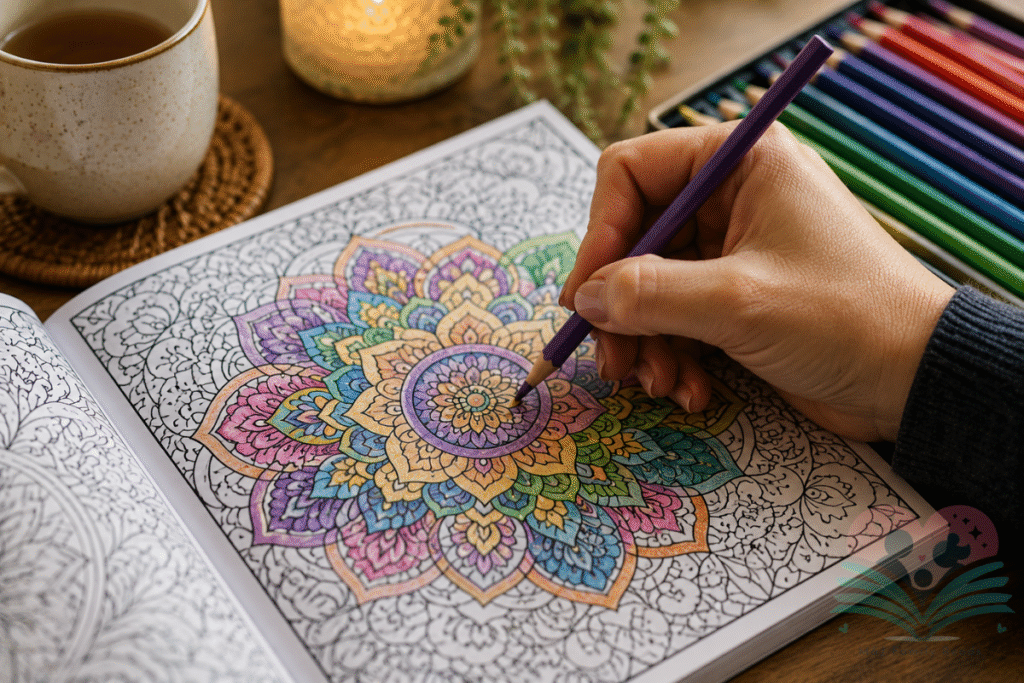
Research suggests that structured coloring activities may help lower perceived stress and anxiety, although the evidence is still developing. A 2026 meta-analysis covering 17 studies and 987 hospitalized adults found significant reductions in anxiety and stress associated with mandala coloring. The researchers also noted that the certainty of the evidence ranged from low to very low, so readers should interpret the results carefully.
Other controlled studies have reported similar results in specific groups. For example, research has examined mandala coloring among caregivers, hospital patients, and people preparing for medical procedures, with several studies reporting reductions in stress or anxiety.
That does not mean coloring is a treatment for anxiety or chronic stress.
Instead, think of it as an accessible way to relax.
When you color, your attention moves toward small decisions: Which color comes next? Where should you shade? Which section will you finish?
For a while, your mind has somewhere specific to go.
And sometimes, that small shift is exactly what you want after a demanding day.
The biggest benefit of a stress relief coloring book is simplicity. You can pick it up for five minutes or settle in for a longer session, and you need little more than pencils, crayons, or markers to get started.
Here are a few reasons adults are adding coloring to their downtime:
Many of our attempts to relax still involve a screen.
Scrolling social media or watching another video can keep information flowing into your brain. Coloring offers an alternative activity that doesn’t depend on notifications, feeds, or apps.
Coloring asks you to focus on the page in front of you.
Selecting colors and filling in individual spaces creates a naturally focused activity without requiring you to master a complicated new hobby.
You do not need an art studio.
A kitchen table, desk, couch, patio, or quiet corner is enough. Keep your coloring book and pencils together, and you can begin whenever you have a few spare minutes.
No single way to color a page is correct.
You can experiment with unexpected color combinations, keep things simple, or spend time adding details. The finished page becomes something you created entirely for yourself.
If creative activities are popular in your household, you may also enjoy exploring the Big Coloring Book for Toddlers for younger family members.
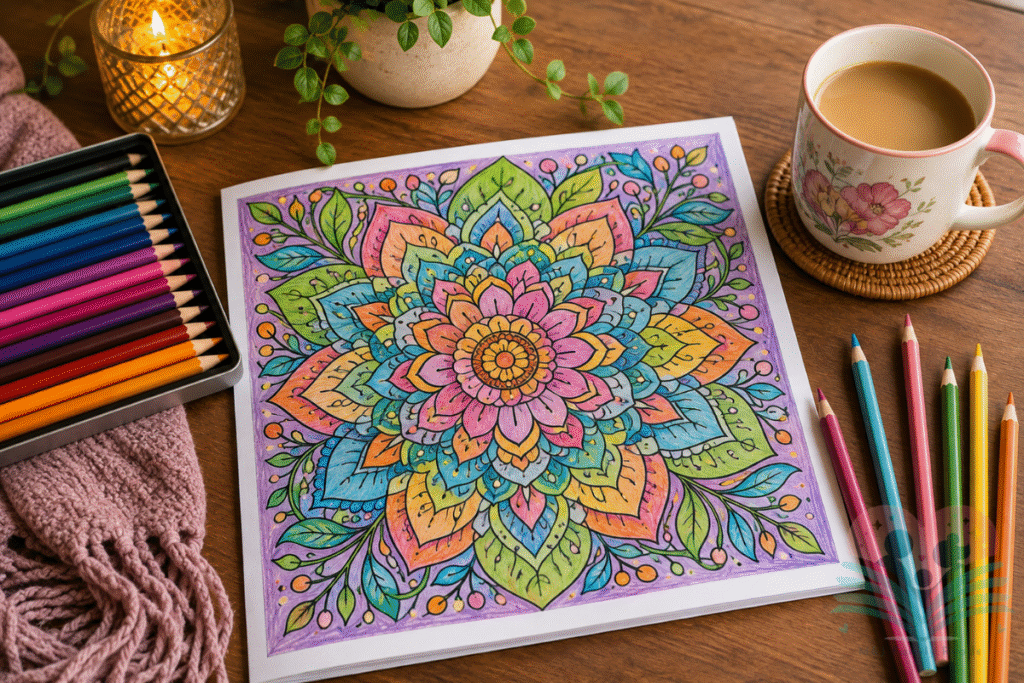
You don’t need a complicated routine to enjoy stress-relief coloring. Start with 10–20 minutes, put distractions aside, and choose a page that feels inviting rather than challenging. The goal is to create a comfortable pause in your day, not another task you have to complete perfectly.
Try this simple routine:
Short sessions are perfectly reasonable. In fact, the 2026 meta-analysis found that coloring interventions lasting 30 minutes or less were associated with reduced anxiety in the studied populations.
You could make coloring part of your morning coffee, an afternoon break, or your evening wind-down routine.
Families looking for other tools to create calmer routines may also find the Tantrum Tracker Workbook useful for identifying patterns and triggers behind children’s difficult moments.
A good stress relief coloring book should contain designs you actually want to color and a level of detail that feels enjoyable rather than overwhelming. The best choice ultimately comes down to personal preference.
Consider:
Most importantly, avoid turning coloring into another performance goal.
You do not have to finish a page.
You do not have to choose the “right” colors.
And you definitely do not have to be an artist.
The value is in enjoying the activity itself.
You can discover more books and family-friendly resources in the MJ Family Reads shop.
Consistency can make coloring easier to turn into a relaxing habit. Instead of waiting until you feel completely overwhelmed, create small opportunities to color throughout your normal week.
For example, keep your book somewhere visible instead of storing it in a drawer. Leave a small container of colored pencils beside it.
Then attach coloring to a moment that already exists in your routine.
After dinner? Color for 15 minutes.
Before bed? Put your phone away and complete part of a page.
Quiet Sunday morning? Make coffee and choose a new design.
The goal isn’t to force relaxation. It is simply to make room for an activity you enjoy.
Coloring may help some people feel calmer and more focused. Research into mandala coloring has found reductions in stress and anxiety in several studied populations, but evidence quality varies, and more high-quality research is needed.
There is no required amount of time. Try 10–30 minutes and see what feels comfortable. Research on mandala coloring has found benefits in interventions of 30 minutes or less in some populations.
No. Coloring can be enjoyed at many ages, although adult stress relief coloring books typically feature designs and detail levels created with adult users in mind.
Colored pencils are an easy starting point because they provide good control over detailed areas. Depending on the paper and design, crayons, gel pens, or markers may also be enjoyable.
Coloring can be a relaxing creative activity, but using a coloring book independently is not the same as professional art therapy or mental health treatment. If stress or anxiety is persistent or affecting daily life, consider speaking with a qualified healthcare or mental health professional.
You do not always need an elaborate routine to create a calmer part of your day.
Sometimes, all you need is a comfortable seat, a handful of colored pencils, and a page waiting to be filled.
A stress relief coloring book gives you an accessible way to step away from screens, enjoy a creative activity, and focus on something simple for a while.
Ready to add coloring to your downtime?
Explore the Stress Relief Coloring Book from MJ Family Reads and start a quiet coloring ritual.
Coloring Book for Anxiety and Stress Relief: 30 Calm Designs says:
[…] For more ideas on incorporating this activity into everyday life, read MJ Family Reads’ guide to using a stress relief coloring book as a simple way to unwind. […]
Coloring Books for Teens: 30 Creative Stress Relief Designs says:
[…] For more ideas around this type of activity, read MJ Family Reads’ guide to using a stress relief coloring book for a simple creative break. […]
Butterflies and Flowers Coloring Book: Creative Fun 6-12 Old says:
[…] Family Reads discusses the same idea in its guide to using a stress relief coloring book as a simple way to unwind. Coloring can create a screen-free pause and help you focus on one manageable […]