
A tantrum tracker workbook helps parents record what happened before, during, and after a child’s tantrum so they can spot recurring triggers and helpful responses. Instead of relying on memory after a stressful moment, you build a simple record that can make patterns easier to recognize.
The Tantrum Tracker Workbook from MJ Family Reads gives parents a practical way to observe those patterns and make calmer, more informed parenting decisions.
You are halfway through getting everyone out the door when it happens.
Your child refuses their shoes. Then comes the crying, yelling, dropping to the floor, or complete refusal to move.
Yesterday it happened before dinner. Last weekend, it happened at the store.
It can feel unpredictable because each tantrum looks like a separate event. A tantrum tracker workbook gives you a way to step back and look at those moments together.
Instead of asking only, “How do I stop this tantrum?” you begin asking:
What tends to happen before these tantrums begin?
That small change can give you useful information.
The Tantrum Tracker Workbook helps parents organize those observations in one place so they can look for patterns instead of relying on memory alone.
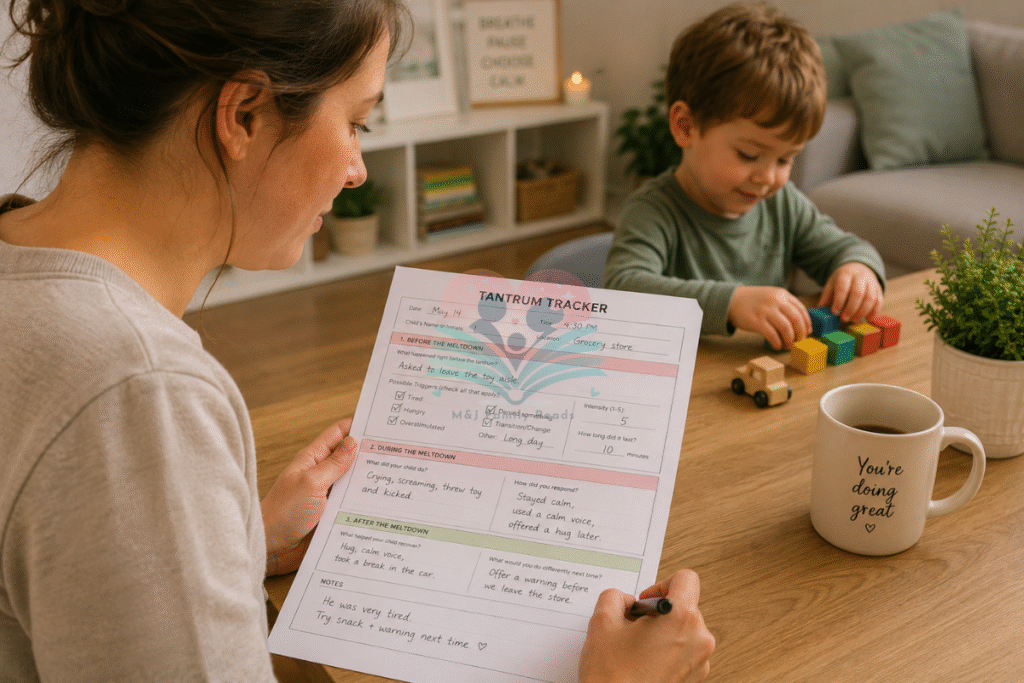
A tantrum tracker workbook is a structured tool for recording tantrums and the circumstances surrounding them. Parents can use it to document when an episode happened, possible triggers, what the child did, how the parent responded, and what eventually helped.
The goal is not to create a report card for your child.
It is to gather useful information.
Existing tantrum-tracking tools commonly record details such as the triggering event, duration, behaviors, caregiver response, location, and what helped resolve the episode.
Over time, those details can help turn a collection of difficult moments into something you can actually review.
For example:
| What You Notice | Possible Pattern to Explore |
| Tantrums frequently happen before dinner | Look at the late-afternoon routine |
| Meltdowns occur when leaving somewhere fun | Explore difficulty around transitions |
| Certain responses appear to calm things faster | Record and repeat what seems helpful |
| Tantrums happen in similar environments | Look for recurring situational triggers |
You are not trying to reach a conclusion from one difficult afternoon.
You are looking for repetition across multiple situations.
For more help understanding what may be happening underneath a tantrum, explore The Tantrum Tamer: How to Decode & Prevent Tantrums.
The simplest way to use a tantrum tracker workbook is to record the important details soon after the situation has settled. Focus on observable facts first, then review several entries later for patterns.
Start with the minutes leading up to the meltdown.
Ask yourself:
Keep the description specific.
“Had a bad afternoon” gives you little to compare later.
“Started crying when I said it was time to leave the playground” gives you something concrete.
Record what you actually observed rather than what you think your child intended.
You might note crying, yelling, refusing, throwing an object, lying on the floor, or trying to leave.
You can also record approximately how long the episode lasted. Duration is a common element in behavior trackers because it adds another detail you can compare across incidents.
Your response is part of the pattern too.
What did you say?
Did you offer space? Redirect? Wait quietly? Change the environment?
And most importantly:
What happened next?
Other tantrum-tracking resources similarly emphasize recording the caregiver response and what appeared to calm or resolve the situation.
If staying calm during these moments is difficult, the Calm Parent Playbook offers additional strategies for managing your own response while supporting your child.
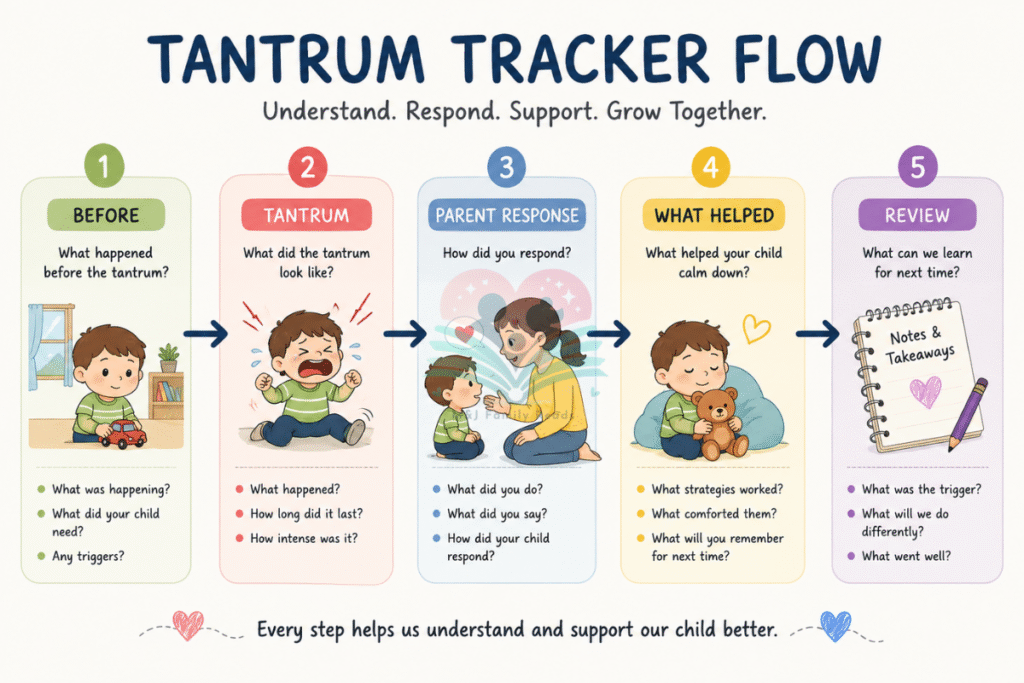
The real value of tantrum tracking appears when you compare multiple entries rather than focusing on a single incident. Repeated information can highlight situations, responses, or routines worth paying closer attention to.
After several entries, sit down when things are calm and review them together.
Look for repeated answers.
Maybe several tantrums happen around transitions.
Perhaps a particular part of the daily routine keeps appearing.
Maybe public outings are especially difficult, or one type of response seems more helpful than another.
Modern tracking tools are built on this same idea: record individual episodes, then review the information to better understand triggers and responses.
1. Timing
Do difficult moments repeatedly occur around similar parts of the day?
2. Situations
Are transitions, errands, stopping an activity, or particular environments appearing repeatedly?
3. Parent responses
What approaches seem to help the situation settle?
4. Outcomes
What happened after the tantrum, and are there similarities across episodes?
You may discover something you couldn’t see while dealing with each incident individually.
That is the purpose of tracking: less guessing, more observation.
Once you notice a recurring pattern, use it as information for planning – not as proof that every future tantrum will have the same cause. Try one manageable adjustment and continue tracking what happens.
Suppose leaving the playground repeatedly appears in your workbook.
You might experiment with a more predictable transition routine.
If crowded public outings repeatedly appear, you can think ahead about how you will respond before the next outing.
For practical ideas specifically for those situations, read How to Deal With Public Tantrums: Calm & Effective Strategies.
Tracking can also make conversations with other caregivers more specific. Instead of saying, “There have been lots of tantrums lately,” you have written observations about when they occurred and what happened around them.
The workbook does not need to give you an instant solution.
Its job is to help you notice what you might otherwise miss.
A tantrum tracker workbook is a structured place to record tantrums, possible triggers, behaviors, responses, and outcomes. Reviewing several entries can help parents notice recurring patterns.
Useful details can include when and where the tantrum happened, what occurred immediately beforehand, what your child did, how you responded, approximately how long it lasted, and what seemed to help.
Consistency is more useful than documenting every tiny detail. Record enough similar incidents to give yourself information you can compare over time.
A tracker cannot guarantee that tantrums will stop. It can help you identify recurring situations and triggers, giving you better information for planning routines and responses.
No. The basic idea of documenting behavioral episodes and looking for patterns is used across different age groups and settings. The key is choosing a tracker that fits your child and your reason for tracking.
When tantrums keep happening, it is easy for one difficult moment to blur into the next.
A tantrum tracker workbook gives you a place to capture those details.
You can record what happened, review recurring patterns, notice what helps, and approach future situations with more useful information.
If you are ready to start tracking those patterns, explore the MJ Family Reads Tantrum Tracker Workbook on Amazon:
A few minutes of observation after a difficult moment can give you information that is hard to see in the moment.
Tantrum Workbook for Parents: 7 Day Practical Companion says:
[…] parents who want to concentrate specifically on identifying recurring patterns, this guide to using a tantrum tracker workbook explains how recording what happens before, during, and after an outburst can make triggers easier […]