
An emotional regulation workbook for parents can help you slow down, recognize patterns behind difficult moments, and respond more intentionally to your child’s big feelings. Rather than trying to figure everything out in the middle of a meltdown, a workbook gives you a structured place to reflect on triggers, responses, and what seems to help.
If you want a practical place to start, explore the MJ Family Reads workbook on Amazon.
You have asked three times.
Your child is crying, shouting, refusing to move, or melting down over something that seemed minor just minutes earlier.
You know you want to respond calmly. But when you are tired, rushed, overstimulated, or frustrated yourself, knowing what to do and actually doing it can feel like two different things.
This is where an emotional regulation workbook for parents can be useful.
It gives you a place to reflect when things are calm, so you are not trying to analyze the entire situation while emotions are running high. You can record what happened, look for patterns, and gradually build a response plan based on what you actually observe in your family.
For parents dealing specifically with repeated meltdowns, a tantrum workbook for parents can also help you document triggers, behaviors, responses, and outcomes over time.
An emotional regulation workbook for parents is a structured resource that helps caregivers better understand emotional triggers, reactions, patterns, and coping responses.
Instead of relying on memory after a difficult day, you can write down what happened and review those observations later.
A useful workbook may encourage you to explore questions such as:
The goal is not to create a perfect record of family life.
It is to make recurring patterns easier to see.
For example, you might discover that the hardest moments tend to happen when everyone is rushing out the door, when an enjoyable activity has to end, or during a particular part of the evening routine.
Those observations give you something specific to work with.

A workbook can help parents move from reacting to individual tantrums toward understanding the situations that repeatedly surround them.
A tantrum at the grocery store may feel completely different from a meltdown when it is time to leave the playground.
After recording several situations, however, you might notice that both happened during a transition.
That pattern matters.
Your notes might reveal:
| What You Notice | What You Can Explore |
| Meltdowns frequently happen during transitions | Make upcoming changes more predictable |
| Difficult moments happen when the family is rushing | Look at where more preparation time may help |
| One response repeatedly seems useful | Try using it more consistently |
| The same routine creates conflict | Examine what happens immediately beforehand |
| You become overwhelmed at the same point | Identify your own early signs of stress |
You do not need to decide immediately what every pattern means.
Start by observing it.
The MJ Family Reads toddler tantrum workbook guide explains this approach in more detail, including how parents can record what happens before, during, and after meltdowns.
Preparing before difficult moments can give you more options when emotions rise.
One useful part of an emotional regulation workbook for parents is identifying the early signs that you are becoming overwhelmed.
Your signs might include:
These signals can become useful information.
When you recognize them earlier, you may be able to pause, simplify what you are saying, reduce stimulation, or choose a response you have already planned.
You can do the same observation with your child.
Perhaps they become more restless before a meltdown. Maybe transitions become harder when they are already frustrated. Perhaps a certain routine repeatedly creates emotional overload.
Write down what you see rather than trying to guess what your child intended.
Over time, those observations can help you prepare for situations that previously felt unpredictable.
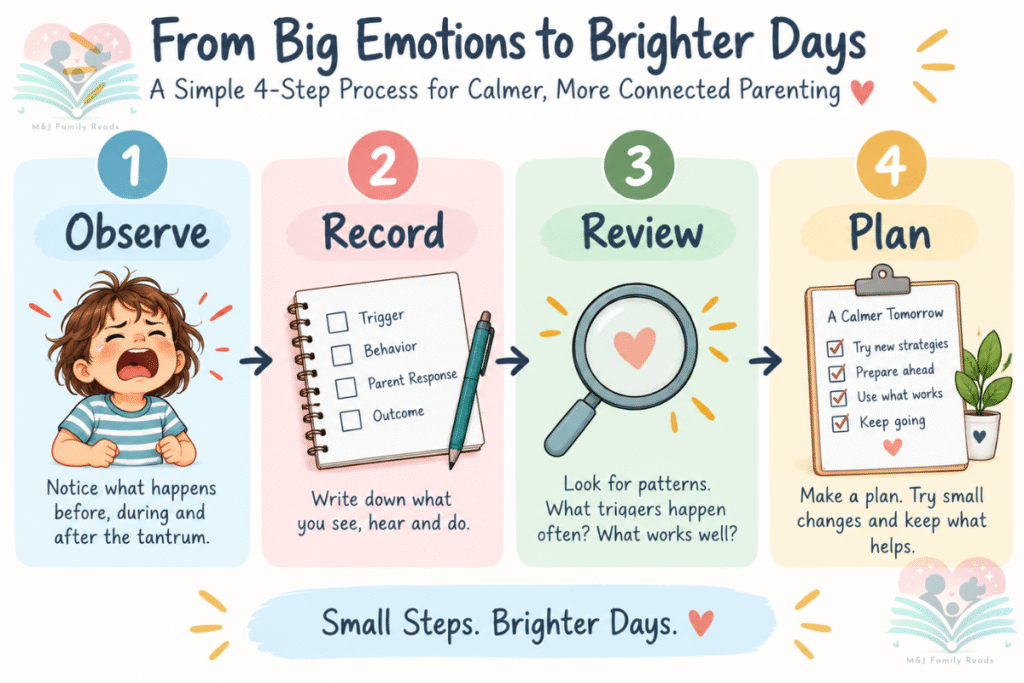
You do not need to complete pages of exercises every day for a workbook to be useful. A short routine of observing, recording, reviewing, and planning can make reflection easier to maintain.
Notice what happened before emotions escalated.
Where were you? What was happening? Was there a transition, boundary, request, change of plan, or other recurring situation?
Once everyone is calm, write down the important details.
Include your child’s behavior, your response, your own emotional state, and what happened afterward.
After several entries, look for repetition.
One difficult event may tell you very little. Several similar situations can provide much more useful information.
Choose one small adjustment to experiment with.
You might prepare differently for a transition, change how you communicate a boundary, or plan what you will do when you notice your own stress increasing.
Then observe what happens next time.
If tantrums are the main challenge in your home, The Tantrum Tamer from MJ Family Reads provides additional guidance on understanding triggers, responding during emotional outbursts, and setting boundaries.
A useful emotional regulation workbook should make reflection easier to use in everyday family life.
Look for prompts that help you capture both the situation and your response without requiring a long journal entry after every difficult moment.
Helpful features may include:
Most importantly, choose something you can realistically use.
A beautifully designed workbook sitting untouched on a shelf will not tell you much. A few specific notes recorded consistently can give you far more information about recurring situations in your family.
An emotional regulation workbook for parents is a structured tool that helps caregivers record emotional triggers, reactions, patterns, and responses. It can provide a practical way to reflect on difficult moments and prepare for similar situations in the future.
A workbook cannot guarantee a calm response every time. It can help you identify your own triggers and early signs of stress, reflect on previous responses, and decide in advance what you want to try during future difficult moments.
Consistency matters more than completing it every day. You might make a short entry after significant emotional moments and then review several entries together to look for recurring patterns.
Yes. Tracking situations, behaviors, parent responses, and outcomes can be especially useful when toddler tantrums seem unpredictable. The process can help you notice patterns around transitions, routines, boundaries, and other recurring situations.
No. A workbook is an educational and reflective tool, not a replacement for individualized medical or mental health care. If you are concerned about the frequency, severity, or nature of your child’s behavior, or about your ability to cope, consider speaking with a qualified professional.
Parenting through big emotions can make each difficult moment feel like a new problem you have to solve immediately.
An emotional regulation workbook for parents gives you another approach.
Observe what happened. Record the details. Review several situations together. Then use what you notice to prepare for the next one.
You do not need to solve every emotional moment at once.
You need a practical way to understand what keeps happening and decide what you want to try next.
If you are ready to put those observations in one organized place, explore the MJ Family Reads emotional regulation workbook for parents on Amazon and start building a clearer picture of your family’s emotional patterns.