
A toddler tantrum workbook gives parents a practical place to record meltdowns, identify possible triggers, notice recurring patterns, and learn which responses seem to help. Instead of trying to remember every difficult moment, you can turn everyday observations into useful information that helps you approach future tantrums with more confidence.
The MJ Family Reads Tantrum Tracker Workbook makes that process simple and manageable for busy parents.
Toddler tantrums can seem to appear out of nowhere, especially when one starts over something as small as the wrong cup, leaving the playground, or putting on shoes. Young children are still developing the skills needed to manage frustration, disappointment, transitions, and other big feelings.
You know the moment.
Breakfast was fine. Everyone was getting ready. Then you said it was time to put the toys away.
Suddenly, your toddler is crying on the floor.
The difficult part is that tomorrow’s meltdown may happen somewhere completely different.
That can make tantrums feel random.
A toddler tantrum workbook helps you capture the details that are easy to forget once the moment has passed. Over time, those observations may reveal situations that keep showing up.
For example, you may notice more difficult moments around transitions, certain routines, particular environments, or specific times of day.
Current tantrum guides and workbooks commonly focus on identifying triggers, recording caregiver responses, tracking outcomes, and developing more consistent ways to respond.
If you want a structured place to start, the MJ Family Reads Tantrum Tracker Workbook can help you organize these observations instead of relying on memory.
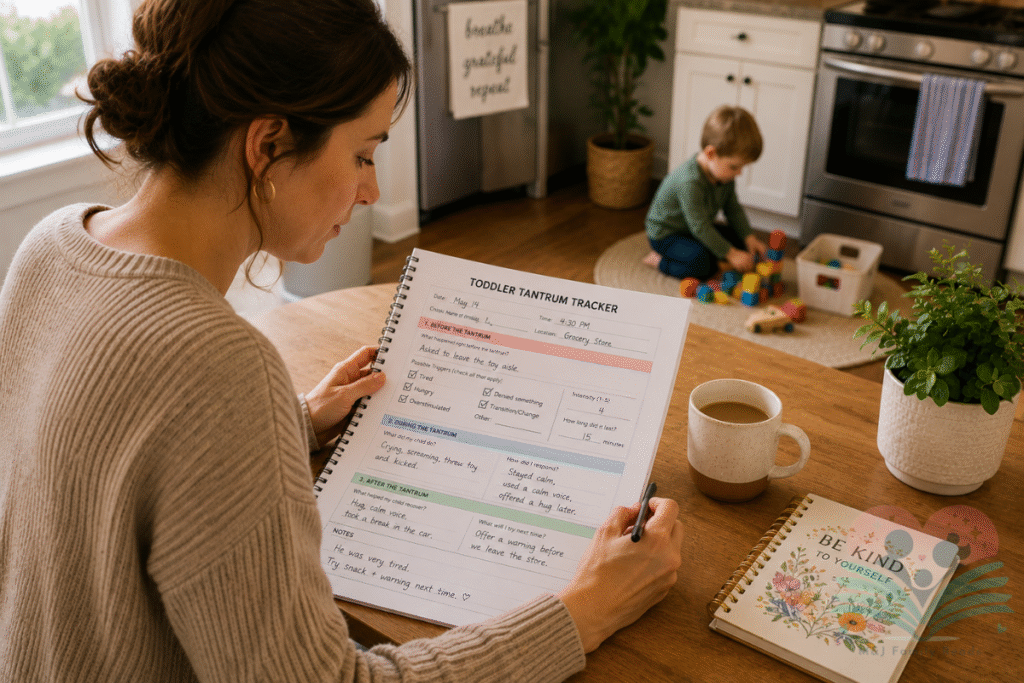
A toddler tantrum workbook is a structured tool parents can use to document tantrums and the circumstances surrounding them. Rather than simply writing down that a tantrum happened, you record details that may help you understand what tends to happen before, during, and after these moments.
A useful entry might include:
The purpose isn’t to turn parenting into a data project.
It is simply to notice what is difficult to see in the middle of a stressful moment.
Imagine your toddler has three meltdowns in one week.
On Monday, it happened when you left the park.
On Wednesday, it happened when screen time ended.
On Saturday, it happened when it was time to leave Grandma’s house.
Those situations look different at first. Once written down, however, you might notice something worth exploring: all three happened when an enjoyable activity had to end.
That’s the value of tracking.
For a deeper look at the process, read the MJ Family Reads guide on how a tantrum tracker workbook helps you spot triggers.
The easiest way to use a toddler tantrum workbook is to record a few clear observations after everyone has settled. You do not need to document every second. Focus on facts you can compare later and avoid trying to solve the entire tantrum while you are recording it.
Write down what was happening shortly before the tantrum began.
Was your toddler asked to stop playing?
Were you getting ready to leave?
Had a request been denied?
Did something unexpected change?
Specific notes are far more useful than broad descriptions.
Instead of writing:
“He was in a bad mood.”
Try:
“He started crying after I said it was time to leave the playground.”
The second entry gives you something concrete to compare with future situations.
Describe the behavior rather than guessing what your child intended.
You might record crying, yelling, dropping to the floor, refusing to move, throwing an object, or another observable behavior.
If practical, note roughly how long the tantrum lasted.
Your response is useful information too.
Did you wait quietly? Offer comfort? Repeat a boundary? Redirect your toddler? Change the environment?
Then record what happened next.
One tantrum rarely tells the whole story.
After you have several entries, look across them and ask:
What keeps appearing?
You might find patterns around:
| What you notice | What you could explore |
| Tantrums before meals | The surrounding routine and timing |
| Meltdowns when leaving fun places | Transitions and advance warnings |
| Difficulties during busy outings | The environment and routine |
| One response frequently helps | Whether using it consistently is useful |
If you want more ideas for understanding what may sit underneath recurring meltdowns, explore The Tantrum Tamer from MJ Family Reads.
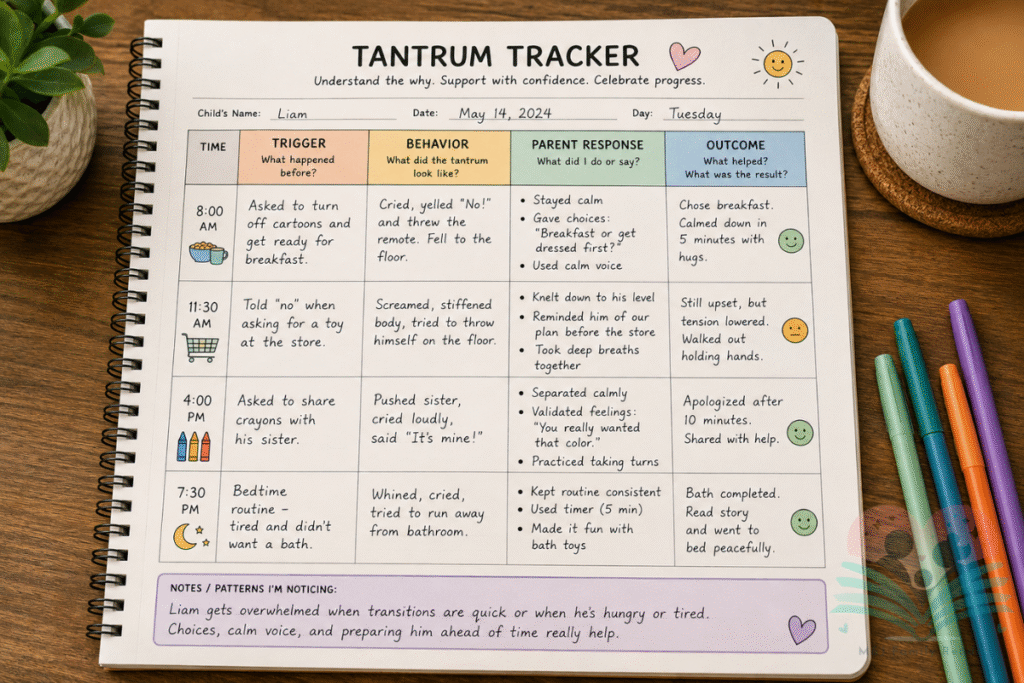
Finding a pattern gives you something specific to explore. It does not mean every future tantrum will have the same cause. Use the information to make one manageable adjustment, then continue observing what happens.
Suppose your workbook shows that leaving the playground frequently leads to a difficult transition.
Instead of approaching the next visit exactly the same way, you could experiment with making the transition more predictable.
If several difficult moments occur during busy parts of the day, look more closely at that routine.
The important shift is simple:
You have moved from “Why does this keep happening?” to “Here is a situation that keeps appearing in my notes.”
That is much easier to work with.
A toddler tantrum workbook can also make conversations between parents, grandparents, babysitters, or other caregivers more specific because everyone has observations they can discuss.
For quieter moments between busy routines, screen-free activities can also give toddlers an opportunity to slow down and focus. MJ Family Reads has a guide to using a big coloring book for toddlers as a simple early-learning activity.
A useful workbook should be simple enough that you will actually use it. Look for clear prompts, repeatable tracking pages, room for observable details, and a format that makes it easy to review multiple tantrums.
You shouldn’t need to write an essay after every meltdown.
A practical workbook helps answer a few useful questions:
What happened before?
What did I observe?
How did I respond?
What happened afterward?
Does this resemble anything I’ve recorded before?
That structure can be especially useful when days feel busy and individual tantrums begin to blur together.
The goal isn’t perfect records.
The goal is better observation.
A toddler tantrum workbook is a structured tool for recording meltdowns, possible triggers, behaviors, caregiver responses, and outcomes. Reviewing entries over time can make recurring patterns easier to notice.
Record useful facts such as when and where the tantrum happened, what occurred beforehand, what your toddler did, how you responded, approximately how long it lasted, and what happened next.
Consistency matters more than recording every small incident. Aim to collect enough similar observations that you have several situations to compare rather than drawing conclusions from a single tantrum.
A workbook cannot guarantee that tantrums will stop. It can help you identify recurring situations and patterns, which may give you useful information for planning routines and responses.
If you are concerned about the frequency, intensity, duration, safety, or developmental aspects of your child’s tantrums, discuss those concerns with your child’s pediatrician or another qualified healthcare professional. A workbook can help you keep organized observations, but it is not a substitute for professional advice.
When you’re dealing with tantrums one at a time, every meltdown can feel like a new problem.
A toddler tantrum workbook gives you a different view.
You can record what happened, compare several situations, notice recurring triggers, and identify responses that appear useful for your child.
You don’t need pages of notes. A few specific observations after each difficult moment can reveal details that are easy to miss in the middle of the meltdown.
If you’re ready to start tracking those moments, explore the MJ Family Reads Tantrum Tracker Workbook on Amazon and begin building a clearer picture of the patterns behind your toddler’s tantrums.