
Practical parenting guides turn parenting advice into clear steps you can use during everyday challenges, from toddler tantrums to difficult transitions and emotional outbursts. Instead of trying to remember parenting theory in a stressful moment, parents can use simple strategies, worksheets, trackers, and routines to understand what is happening and decide what to try next.
For families dealing with frequent tantrums, The Tantrum Tamer from MJ Family Reads provides a practical framework for decoding triggers, preventing avoidable meltdowns, and responding more consistently.
Parenting advice is easy to find. Using it when your toddler is crying on the floor because the blue cup is unavailable can be much harder.
That is where practical parenting guides become useful.
Rather than giving parents more information to remember, a practical guide organizes a specific challenge into manageable actions. Current parenting resources on this topic often emphasize scripts, routines, checklists, printable tools, and step-by-step responses parents can use during difficult moments.
The goal is to give yourself a repeatable process.
For example, instead of thinking:
“How do I make these tantrums stop?”
You can start asking:
These questions move you toward patterns you can observe and actions you can test.
If tantrums are one of the biggest challenges in your home, The Tantrum Tamer: How to Decode & Prevent Tantrums can help you work through those situations more systematically.
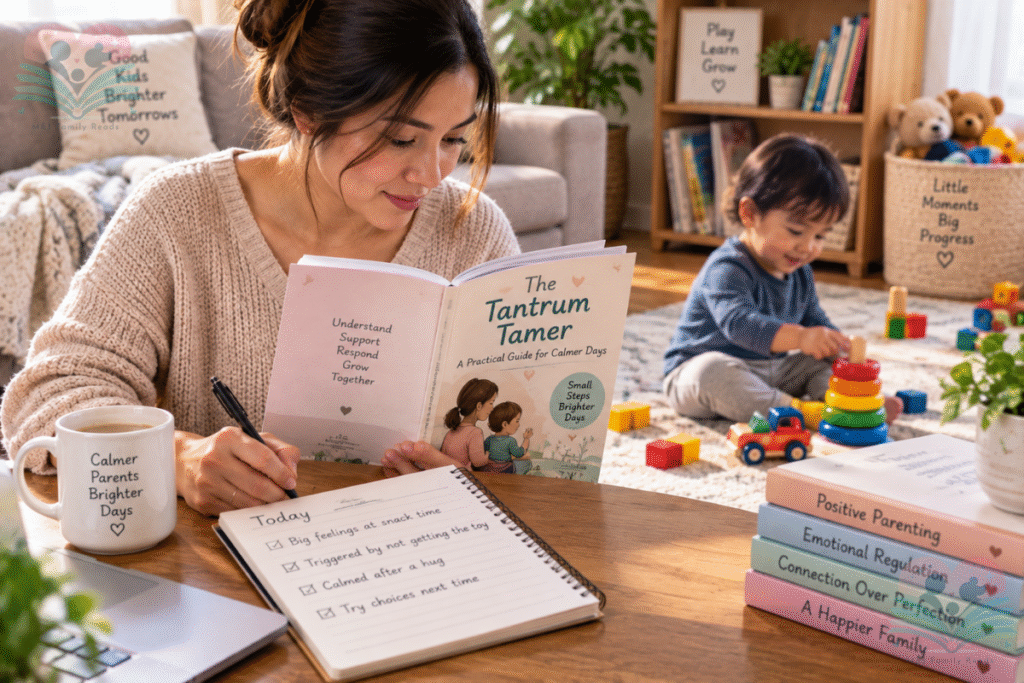
A useful parenting guide should answer a simple question: “What can I actually do with this information?”
Parents rarely need another long explanation when emotions are already running high. They need something they can understand, remember, and use.
That is why many practical parenting resources focus on clear next steps, scripts, routines, quick-reference tools, and printable resources rather than theory alone.
A practical guide may include:
| Tool | How It Helps |
| Step-by-step strategies | Break a difficult situation into manageable actions |
| Trackers | Reveal patterns that may otherwise be easy to miss |
| Worksheets | Turn observations into something concrete |
| Routines | Create more predictability around recurring situations |
| Scripts or prompts | Give parents words to start with in difficult moments |
| Reflection pages | Help identify what worked and what could change |
For tantrums specifically, recording what happens before, during, and after an outburst can give parents useful context.
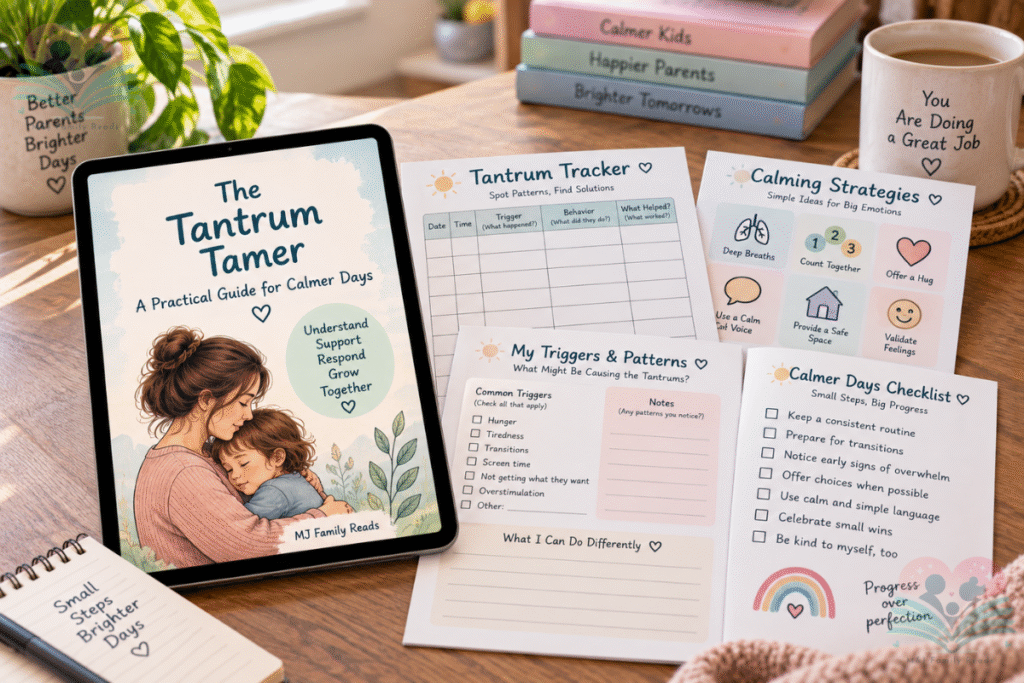
The tantrum tracker workbook from MJ Family Reads is designed around this process, helping parents spot triggers and recurring patterns instead of trying to reconstruct everything from memory later.
The key isn’t filling out pages just for the sake of tracking. It is using those observations to make the next difficult moment easier to understand.
Toddler tantrums can feel unpredictable, but looking at repeated situations can reveal useful patterns.
A practical guide gives you somewhere to record those details and compare them over time. This approach also fits the broader structure seen in current parenting resources, where tantrums and emotional regulation are addressed through routines, triggers, scripts, de-escalation strategies, and preparation for recurring difficult moments.
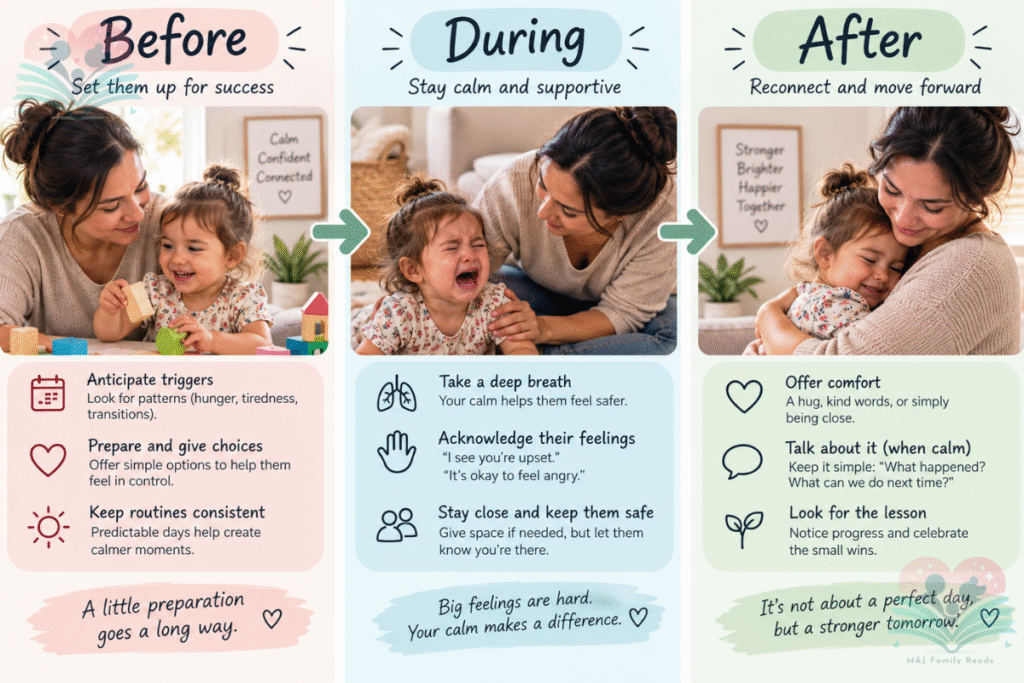
Start with three stages.
Consider what was happening immediately before the tantrum.
Was your child:
One incident may tell you very little. Several similar incidents can reveal a pattern.
Keep the description simple and factual.
Note approximately how long the tantrum lasted, what happened, how you responded, and whether anything appeared to escalate or settle the situation.
You do not need a detailed diary. You need enough information to compare one incident with another.
Once everyone is settled, look back at the situation.
Ask what seemed useful and what you might try differently next time.
The toddler tantrum workbook provides a structured way to work through this process and turn difficult moments into information you can actually use.
A parenting workbook is most useful when it reduces mental load rather than creating another task.
You do not need to document every difficult moment or complete every page immediately. Start with the challenge that is happening often enough to affect family life.
For example, if tantrums repeatedly happen around bedtime, focus on bedtime.
Record a few incidents and look for similarities.
You might notice that the hardest nights share the same circumstances. That gives you something specific to experiment with, such as adjusting the transition into the bedtime routine or making expectations clearer beforehand.
The tantrum workbook for parents offers a practical way to organize these observations rather than keeping every detail in your head.
Try this simple cycle:
Observe → Record → Review → Adjust → Repeat
The value comes from the pattern, not from completing a perfect worksheet.
Parenting rarely follows a perfectly predictable script. A useful guide gives you a starting point and a way to learn from what happens next.
The best practical parenting guide for your family should match the problem you are trying to solve right now.
A guide focused on toddler tantrums, for example, should help you understand tantrum situations and give you tools you can realistically use before, during, and after them. A guide for another parenting challenge should be equally specific.
Before choosing one, ask:
Practical parenting resources online often organize themselves around a specific family challenge rather than trying to solve every parenting problem in a single guide.
That specificity can make a guide much easier to use.
Practical parenting guides are resources that turn parenting information into clear actions. They may include step-by-step strategies, worksheets, trackers, routines, scripts, prompts, or other tools parents can use during everyday family challenges.
They can help organize observations and create a consistent approach. A tantrum-focused guide can help parents record triggers, notice patterns, review their responses, and plan what to try next time.
Start with what happened before the tantrum, the situation or trigger, what happened during it, how you responded, approximately how long it lasted, and what appeared to help the situation settle.
Use it often enough to reveal patterns without turning it into another stressful obligation. For recurring challenges, recording several similar incidents may provide more useful information than documenting every event.
No. Parenting guides are educational tools and are not substitutes for individualized medical, developmental, or mental-health advice. If you are concerned about your child’s behavior, development, safety, or well-being, seek guidance from an appropriate qualified professional.
Parenting challenges rarely arrive when you have time to research a perfect response.
That is why practical parenting guides can be valuable: they give you a framework to return to when the same problem keeps appearing.
If toddler tantrums are creating stressful moments at home, start by understanding the patterns behind them.
Explore The Tantrum Tamer from MJ Family Reads to decode triggers, identify patterns, and build a more practical plan for handling tantrums.
One observation can give you information. A pattern can give you a clearer next step.