What to say during a toddler tantrum?
When your toddler is having a tantrum, use short, calm, reassuring phrases such as “I’m here,” “I see you’re upset,” or “It’s okay to feel angry. I won’t let you hit.” Keep your voice gentle, acknowledge their feelings, and maintain clear boundaries. Your child may need time to calm down before they can listen or respond.
You’re standing in the grocery store when your toddler suddenly drops to the floor, screaming because you won’t buy another toy.
People are watching. Your patience is running low. You’ve tried explaining, comforting, and reasoning, but nothing seems to work.
Sound familiar?
Knowing what to say during a toddler tantrum can make these moments easier to navigate.
Young children are still developing the language and emotional skills needed to handle frustration. According to the Centers for Disease Control and Prevention (CDC), caregivers can support emotional development by staying calm, acknowledging feelings, and setting appropriate limits.
At MJ Family Reads, we believe practical parenting tools should be easy to use in real life. Our Tantrum Tamer parenting guide helps parents recognize meltdown triggers and respond with greater confidence.
Let’s explore the phrases you can use when big feelings take over.
The most helpful words during a toddler tantrum are usually brief, calm, and easy to understand. Your goal is to support your child, keep everyone safe, and communicate boundaries clearly. Some toddlers may not be ready to listen until the strongest emotions have passed.
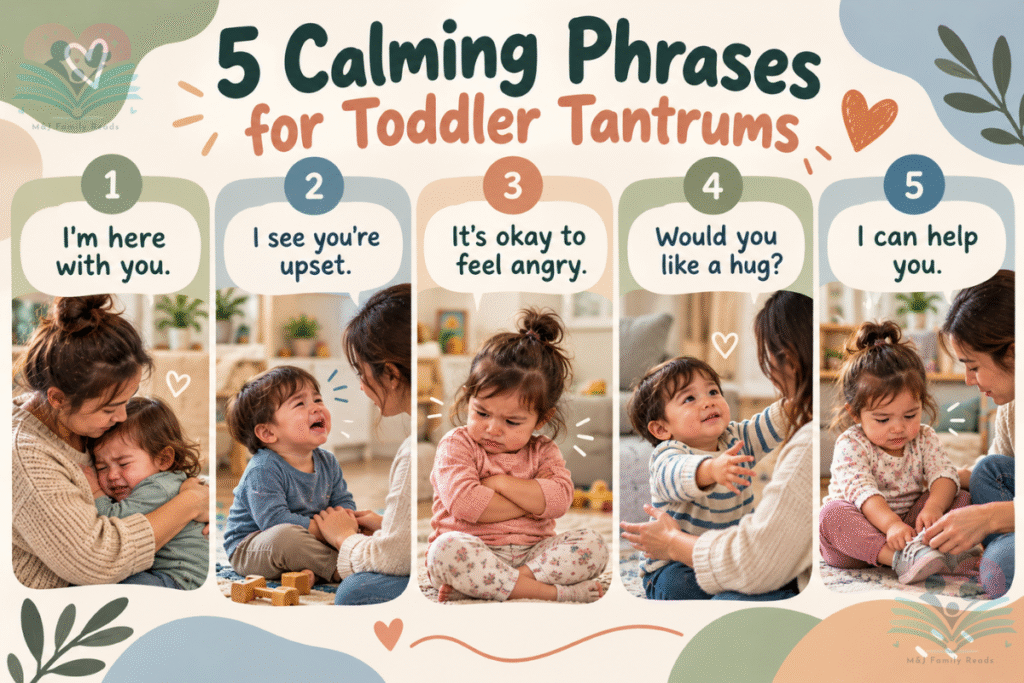
This reassuring phrase reminds your toddler that you’re nearby. Sit close if it’s safe and give them space if they don’t want physical contact.
Naming what you notice can help your child begin connecting feelings with words. You don’t need to solve the problem immediately.
This combines emotional validation with a clear safety boundary. Gently block hitting or move someone out of reach when necessary.
4. “You really wanted that toy.” Acknowledge disappointment without changing your decision.
5. “I’m listening.” Let your toddler know their feelings matter, even if they cannot explain them yet.
6. “You’re having a hard time.” Recognize that frustration can feel overwhelming.
7. “Let’s take a breath together.” Demonstrate slow breathing if your child is receptive. Don’t force it.
8. “Do you want a hug or some space?” Offer comfort while respecting your child’s response.
9. “I can help you.” Reassure a frustrated toddler who is struggling with a task.
10. “The answer is still no.” Maintain a calm, consistent boundary without repeating a long explanation.
11. “You can be upset. We still need to leave.” Acknowledge their feelings while continuing the necessary transition.
12. “Would you like the red cup or the blue cup?” Offer two manageable choices when your toddler is ready to decide.
13. “Let’s find a quiet place.” Move away from overwhelming noise or activity when possible.
14. “That was a big feeling.” After the tantrum, help your child reflect on what happened.
15. “Next time, you can say, ‘Help, please.’” Teach a simple phrase your toddler can practice when calm.
Parenting tip: You don’t need to remember all 15 phrases. Start with three: “I’m here,” “I see you’re upset,” and “I won’t let you hit.”
The right response depends on what triggered your toddler’s meltdown. An exhausted child may need rest, while a child frustrated by a denied request may benefit from a calm boundary. Match your words to the situation, and remember that talking less is often helpful during intense distress.
| Situation | What to say |
| Tantrum in a grocery store | “You wanted that candy. We’re not buying it today.” |
| Refusing bedtime | “You want to keep playing. It’s bedtime now.” |
| Hitting or kicking | “I won’t let you hurt anyone.” |
| Crying over a broken toy | “You’re sad it broke. I’m here.” |
| Refusing to leave the park | “You want to stay. It’s time to go. Walk or hold my hand?” |
| Overwhelmed by noise | “It’s loud here. Let’s go somewhere quieter.” |
These scripts give you words to fall back on when you’re tired, frustrated, or unsure how to respond.
For parents who want to understand the patterns behind repeated meltdowns, the Tantrum Workbook for Parents explains how tracking triggers, reactions, and outcomes can help you plan for challenging situations.
Some common responses can make a difficult moment harder. Shaming, threatening, or giving long explanations may increase distress or distract from the behavior you’re trying to teach. Choose simple language, keep your tone steady, and save detailed conversations for when your child can listen.
| Instead of saying | Try saying |
| “Stop crying!” | “I see you’re upset.” |
| “You’re being naughty.” | “You’re frustrated. I can help.” |
| “What’s wrong with you?” | “Something feels hard right now.” |
| “Because I said so!” | “We’re leaving because it’s time to go home.” |
| “You’re fine!” | “That really disappointed you.” |
Keep in mind that no single phrase works for every child or every tantrum.
Learning to respond calmly takes practice. If you’re navigating the challenges of early parenthood, explore MJ Family Reads’ article on common mistakes new parents make and how to avoid them.
A useful approach is to regulate your own response, protect your child, acknowledge their feelings, set a clear limit, and teach later. This sequence reflects the practical guidance in MJ Family Reads ‘The Tantrum Tamer. It gives parents a repeatable way to handle emotional outbursts.
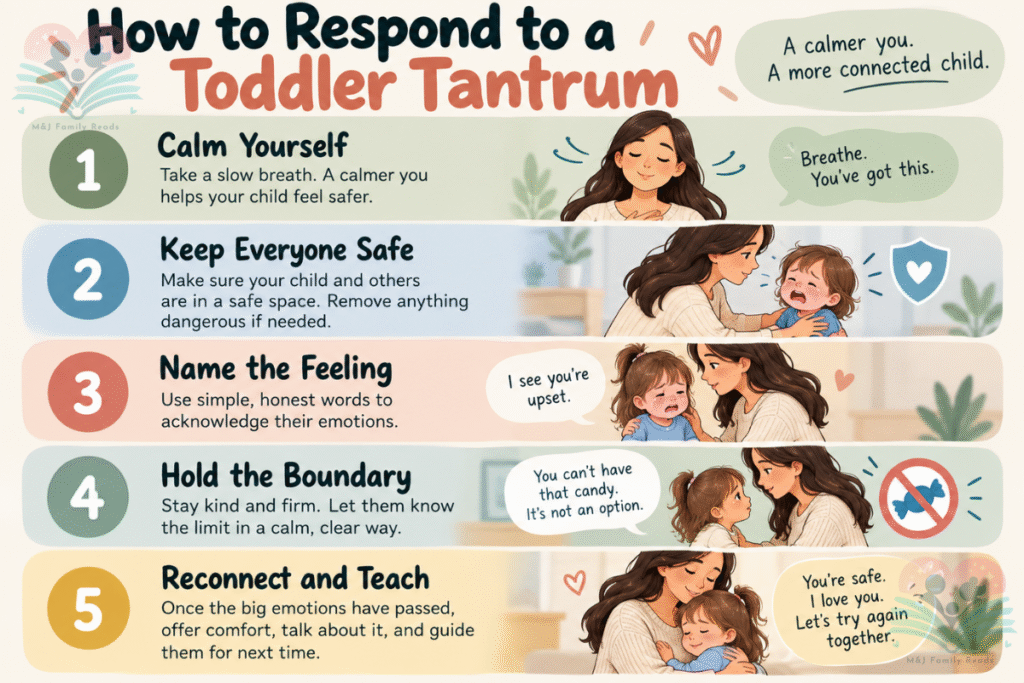
Take a slow breath, relax your shoulders, and lower your voice.
Move dangerous objects away and prevent hitting, biting, or other harmful behavior.
Say, “You feel angry because playtime is over.”
Say, “It’s time to go home.” Offer a simple choice if your child is ready.
When everyone is calm, practice words such as “Help, please” or “I’m mad.”
The American Academy of Pediatrics also recommends staying calm, providing appropriate choices, and understanding tantrums as a normal part of early development.
This method isn’t a promise to stop every tantrum within a set time. It’s a practical structure to help you respond consistently.
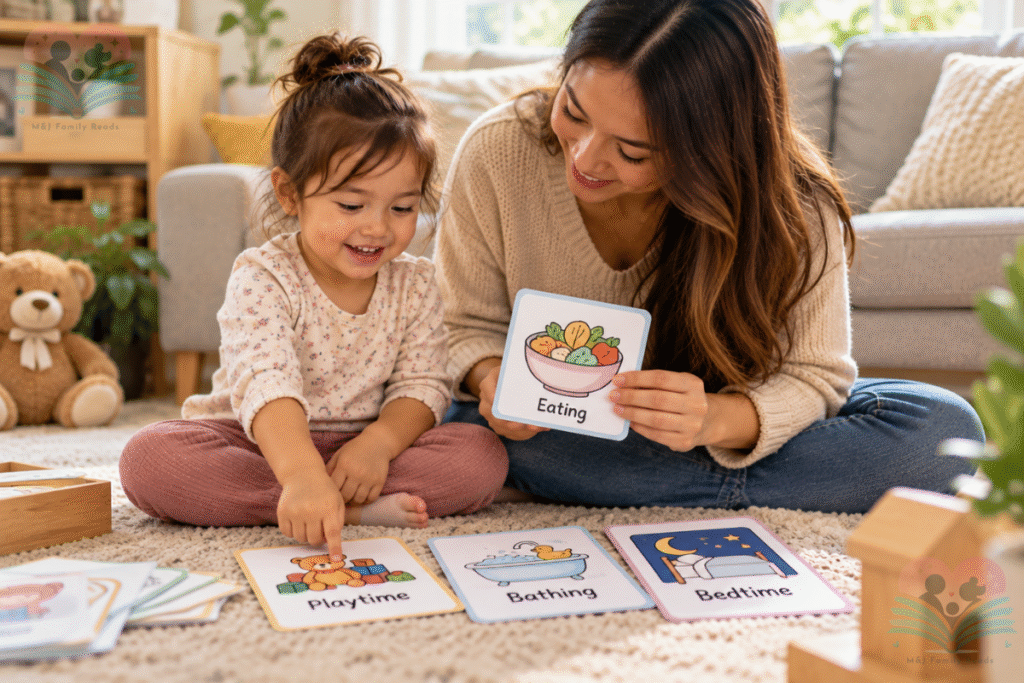
Preventing toddler tantrums begins with understanding your child’s needs and daily patterns. Hunger, tiredness, overstimulation, and unexpected transitions can make frustration harder to manage. Predictable routines, advance warnings, and opportunities for small choices may reduce avoidable meltdowns, though tantrums remain a normal part of development.
Try giving your toddler a five-minute warning before leaving the playground. Keep snacks and water available when appropriate, and build enough rest into the day.
Watch for recurring triggers, including situations where your child struggles to communicate what they want.
If you notice patterns, write them down. The Tantrum Tracker Workbook: Your 7-Day Emotional GPS Companion provides a structured way to observe triggers, record responses, and reflect on your child’s emotional needs.
Start with “I’m here with you” or “I see you’re upset.” These simple phrases communicate reassurance without demanding an immediate response. Stay nearby, keep your child safe, and give them time to settle.
Yes, but use very few words. A toddler experiencing intense emotions may struggle to process instructions. Speak gently when necessary and wait until they are calmer before explaining rules or discussing what happened.
Stay calm, check for safety concerns, and use a reassuring phrase. Reduce noise or stimulation if possible. Offer comfort without forcing a hug. Once your child settles, help them identify what upset them.
Many toddler tantrums last several minutes, although duration varies. Hunger, fatigue, developmental differences, and the situation can affect how long an outburst continues. Speak with a pediatrician if tantrums are unusually prolonged, frequent, severe, involve repeated injury, or significantly disrupt daily life.
Reconnect with your child and briefly name the emotion. You might say, “You were angry when we stopped playing.” Then practice a simple coping skill, such as asking for help, taking a breath, or using words to express frustration.
Learning what to say during a toddler tantrum gives you practical tools for some of parenting’s most challenging moments.
Start with a reassuring phrase. Keep your boundaries clear. Stay close when your child needs support, and remember that emotional regulation develops over time, with practice and patient guidance.
Not every tantrum will end quickly, and that’s okay. Small, consistent responses can help your toddler learn healthier ways to express big feelings.
The Tantrum Tamer from MJ Family Reads offers step-by-step strategies, practical scripts, and the Emotional GPS Method to help you identify tantrum triggers, respond calmly, and support your child’s emotional development.
Digital parenting guide
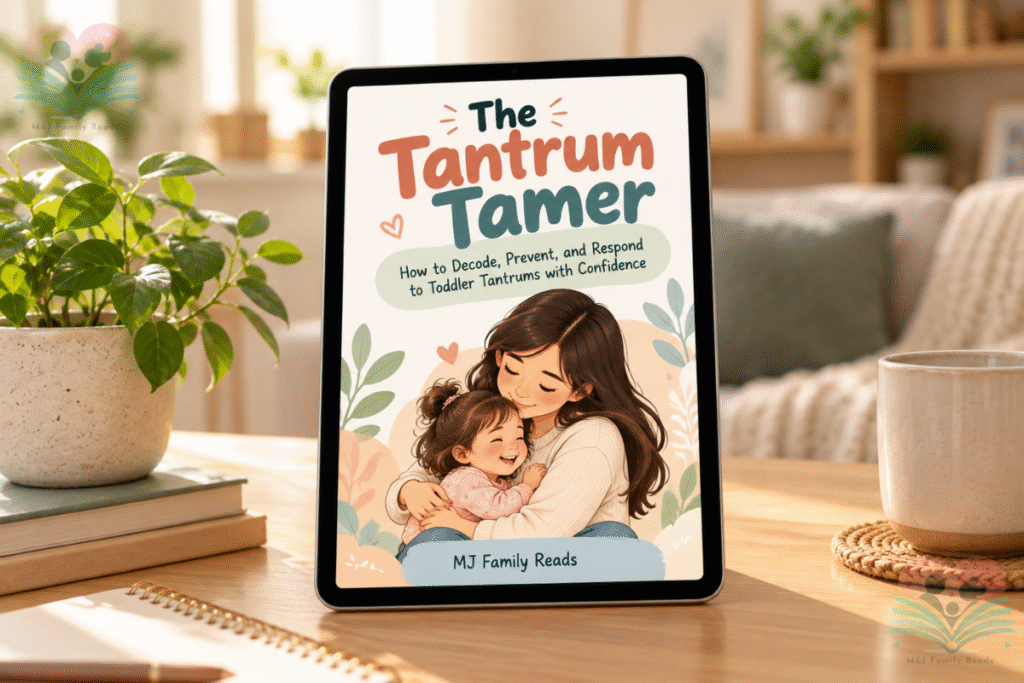
Explore The Tantrum Tamer and start building a calmer parenting routine →
Parenting information is educational and does not replace advice from your child’s pediatrician or a qualified child-development professional.