
A tantrum workbook for parents gives you a structured way to understand what happens before, during, and after your child’s meltdowns. Instead of trying to remember patterns during stressful moments, you can track triggers, record what helped, and build a calmer, more consistent response plan.
The MJ Family Reads Tantrum Workbook for Parents on Amazon is designed to turn those everyday observations into practical information you can use when the next difficult moment arrives.
You are trying to get out the door. Your toddler suddenly refuses to put on their shoes.
Later, dinner becomes another battle.
Then the next day, leaving the playground ends in tears, yelling, or dropping to the ground.
When these moments happen one at a time, they can feel completely unrelated. You deal with the immediate situation, everyone eventually settles, and the day moves on.
A few days later, it happens again.
That is where a tantrum workbook for parents can become useful. It gives you somewhere to record what happened so you can look beyond the individual meltdown and start noticing what repeatedly comes before it.
Instead of depending on memory, you have actual observations to review.
If you want a structured place to begin, explore the MJ Family Reads tantrum workbook for parents on Amazon.

A tantrum workbook for parents is a structured tool for recording and reviewing a child’s tantrums. It can help you document what happened beforehand, how the tantrum unfolded, how you responded, and what happened afterward.
That matters because patterns are hard to see when you experience each meltdown separately.
For example, you may begin noticing that tantrums often happen:
One difficult afternoon does not necessarily tell you much.
Several recorded situations can.
A workbook gives those observations somewhere to live instead of asking you to mentally reconstruct them days later.
For parents who want to concentrate specifically on identifying recurring patterns, this guide to using a tantrum tracker workbook explains how recording what happens before, during, and after an outburst can make triggers easier to recognize.
The simplest approach is to record observable details soon after everyone has settled, then compare multiple entries later. You do not need to analyze the entire situation while your child is upset. Capture the facts first and look for repetition afterward.
Start with the moments leading up to it.
Ask:
Try to be specific.
For example, “My toddler had a difficult afternoon” is hard to compare with future situations.
“Started crying when I said it was time to leave the playground” gives you something concrete.
Next, write down what happened during the tantrum.
Focus on observable behavior rather than trying to decide what your child intended.
You might record crying, yelling, refusing to move, lying on the floor, throwing something, or attempting to leave the situation.
You can also note approximately how long the tantrum lasted.
Your response belongs in the workbook too.
Did you offer a choice? Wait quietly? Repeat a boundary? Redirect your child? Change the environment?
Then record what happened afterward.
Over several entries, you may begin noticing that certain responses appear more helpful in particular situations.
For a broader practical approach to navigating these moments, see this toddler tantrum workbook guide from MJ Family Reads.
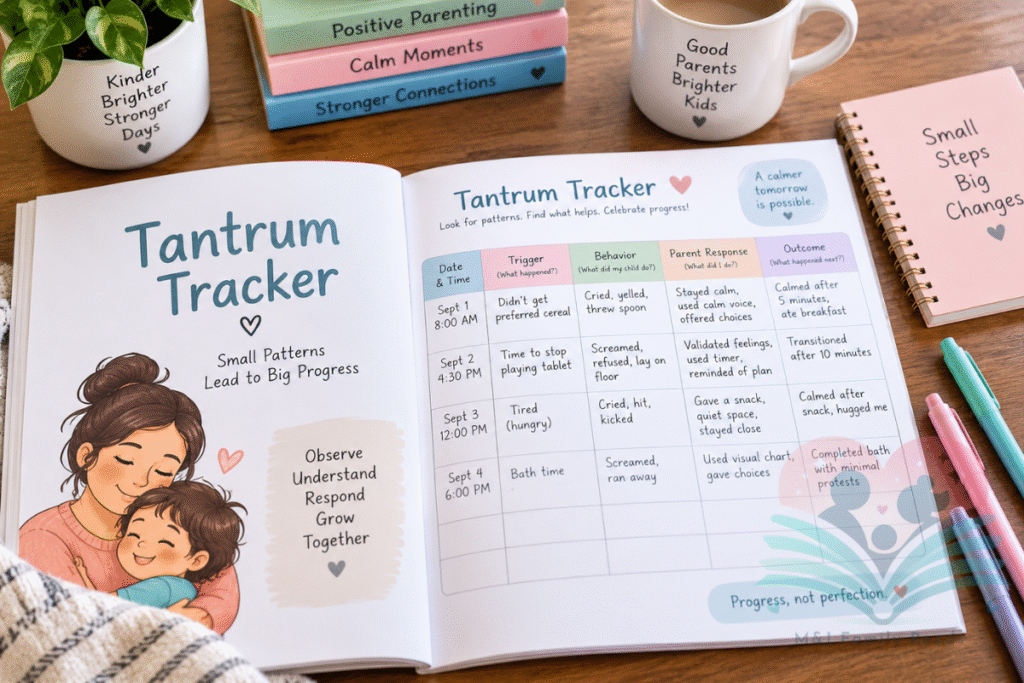
A tantrum workbook for parents can help turn separate difficult moments into information you can compare. Once you have recorded several incidents, review the pages when things are calm and look for details that keep appearing.
A simple review might look like this:
| What You Notice | What to Explore |
| Tantrums often happen before dinner | Look more closely at the late-afternoon routine |
| Leaving fun places regularly triggers tears | Explore how transitions are handled |
| One response seems to help more often | Try using it consistently and keep tracking |
| Certain environments appear repeatedly | Prepare for those situations before arriving |
| Meltdowns happen around the same activity | Look at what occurs immediately before it |
The important word here is pattern.
One tantrum at the grocery store does not automatically mean grocery stores are a trigger. Several similar incidents give you more information to work with.
That is why tracking can be so useful: you move from “Why does this keep happening?” to “What keeps showing up when this happens?”
Once you identify a possible pattern, use it as information for your next experiment rather than assuming you have discovered the single cause of every tantrum. Make one manageable adjustment, observe what happens, and continue tracking.
Imagine your workbook repeatedly shows difficult transitions when leaving the playground.
Before the next visit, you could experiment with making the transition more predictable.
Then record what happens.
Or perhaps your entries show that a certain part of your routine repeatedly becomes difficult. That gives you a specific situation to examine instead of trying to change your entire day at once.
The same principle applies to your responses.
If your notes suggest that one approach consistently makes a particular situation easier to navigate, you now have something concrete to repeat and observe.
Parents who want to go beyond tracking and develop a more structured response to meltdowns can also explore The Tantrum Tamer: How to Decode & Prevent Tantrums from MJ Family Reads. It focuses on understanding triggers, responding calmly, setting boundaries, and using practical strategies during emotional outbursts.
A useful tantrum workbook for parents should make observation easier, not create another complicated parenting task. Look for a format that helps you quickly capture the details you’ll likely want when reviewing several tantrums later.
Useful areas to record include:
The workbook should also be easy enough to use consistently.
You do not need to write a detailed story about every meltdown. A few specific observations can be far more useful than several paragraphs written from memory days later.
Consistency matters more than perfection.
Using a workbook does not have to become another major item on your daily checklist. Keep the process simple: observe, record, review, and adjust.
After a notable tantrum, take a few minutes to capture the key facts once the situation is calm.
After several entries, review what you have recorded.
Look specifically for four things:
Timing: Are difficult moments happening around similar times or parts of your routine?
Situations: Do transitions, errands, stopping activities, or specific environments appear repeatedly?
Responses: What did you do, and which approaches seemed most helpful?
Outcomes: How did the situation end, and are there similarities between incidents?
Then choose one pattern worth exploring.
You are not trying to solve every tantrum at once. You are giving yourself better information for the next one.
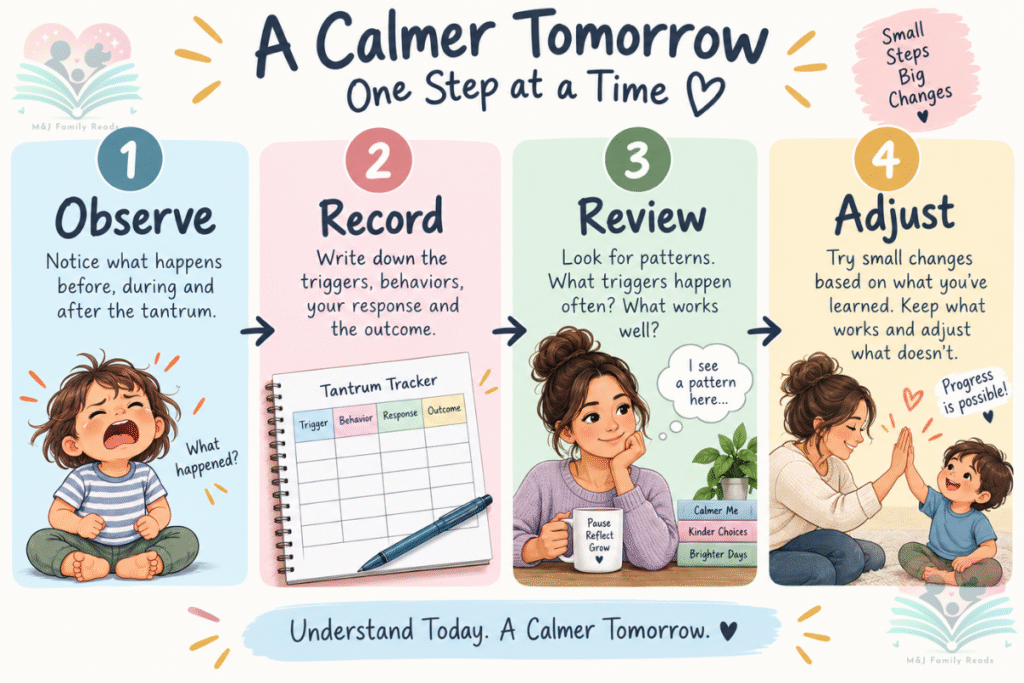
A tantrum workbook for parents is a structured place to record and review a child’s tantrums. Parents can document possible triggers, behaviors, their own responses, and what happened afterward to make recurring patterns easier to identify.
Record what happened immediately before the tantrum, where and when it occurred, what your child did, how you responded, approximately how long it lasted, and what appeared to help the situation settle.
You do not necessarily need to document every moment of frustration. Aim for enough consistent entries to give you situations you can meaningfully compare. Reviewing several incidents is generally more informative than analyzing one isolated tantrum.
A workbook cannot guarantee that tantrums will stop. It can help you recognize recurring situations and patterns, which gives you more information when planning routines, transitions, and responses.
Tantrum workbooks are especially useful for parents navigating the toddler and preschool years, but you can adapt the basic process of recording behaviors, situations, responses, and outcomes to different ages. If you are concerned about the frequency, severity, or nature of your child’s behavior, consider discussing those concerns with a qualified pediatrician or child-development professional.
Parenting through repeated tantrums can leave you wondering what you missed or what you should try next.
A tantrum workbook for parents gives you something practical to work with.
You can record what happened, identify recurring triggers, notice which responses appear helpful, and use those observations when preparing for future situations.
You do not need to figure everything out during the meltdown.
You can observe now and review later.
If you are ready to put those observations in one organized place, explore the MJ Family Reads Tantrum Workbook for Parents on Amazon and start tracking patterns that may be hard to see in the moment.
Emotional Regulation Workbook for Parents: 7 Day Best Guide says:
[…] parents dealing specifically with repeated meltdowns, a tantrum workbook for parents can also help you document triggers, behaviors, responses, and outcomes over […]